How Much Exercise Does a English Cocker Spaniel Need? Plus Brain Games
General training information. Every dog is an individual; for health or behavior concerns, see your veterinarian.
English Cocker Spaniels are happy, busy dogs. The English Cocker Spaniel Club of America, the breed's parent club, describes them as merry, intelligent, athletic and affectionate. They were bred to work, and a bored spaniel can be a noisy, chewy, restless housemate.
This guide shows you how to build a daily routine that covers both body and brain. You will get a step-by-step plan for English Cocker Spaniel exercise, plus simple games that give your dog's mind a real job. Every dog is an individual, so treat the plan as a starting point and adjust it to your own dog.
What the Breed Was Built to Do
The parent club says English Cockers were developed to flush woodcock, and to find, flush and retrieve upland game. That job explains a lot. A dog bred to cover ground, follow scent and bring back game needs more than a quick lap around the block.
Westminster Kennel Club lists the breed in the Sporting Group and rates its energy at 3 out of 5, describing it as energetic. It rates trainability at 4 out of 5. That is a good mix for a family that enjoys being active and likes teaching their dog new things.
Dogs vary. Some English Cockers are happy with a calm routine. Others seem to have no off switch. Watch your own dog and let that guide you.
So, How Much Exercise Does an English Cocker Spaniel Need?
The honest answer is plenty, every day. Orvis, a retailer that publishes a breed guide, says the breed needs plenty of daily exercise. None of the breed sources we relied on give an exact number of minutes, so we will not invent one.
Instead of a stopwatch, use a simple test. A well-exercised English Cocker is relaxed and settles at home after activity. If your dog paces, chews furniture, barks for attention or cannot settle in the evening, the routine probably needs more of something. That something is often mental work, not just more miles.
The parent club gives the adult size as about 16 to 17 inches and 28 to 34 pounds for males, and about 15 to 16 inches and 26 to 32 pounds for females. That is a sturdy, medium-sized dog. It has real stamina but is not built like a giant breed.
Exercise by life stage
| Life stage | What to aim for | What to check |
|---|---|---|
| Puppy | Short, gentle play, easy walks and sniffing. Keep sessions brief and stop before your puppy is worn out. | Ask your veterinarian and your breeder how much and what kind of exercise is safe while joints and bones are growing. We could not find a breed-specific limit from the parent club, so we will not give one. |
| Adult | Plenty of daily exercise, split across the day, with a mix of walking, off-leash or long-line running in safe areas, fetch and brain games. | Watch for tiredness, limping or heavy panting, and let your veterinarian know if anything looks off. |
| Senior | Shorter, more frequent outings, steady walks and plenty of sniffing. Keep the brain games going. | Ask your veterinarian how to adjust the routine. The parent club cites an average life expectancy of about 14 years, but individual dogs vary. |
If your puppy is young, please do not go looking for a rule of thumb online and apply it blindly. Your veterinarian can look at your actual dog and tell you what suits their growth and health.
What You Will Need
You do not need much. Gather these before you start:
- A well-fitted flat collar or a comfortable harness, and a standard leash.
- A long line for safe sniffing and running room when off-leash recall is not yet reliable.
- Small, soft treats that your dog loves, cut into tiny pieces.
- A puzzle feeder or a snuffle mat, or a few household items such as a muffin tin and tennis balls.
- A soft retrieve toy that is easy to carry in the mouth.
- A few cardboard boxes, towels or paper bags for scent games.
- Fresh water and a towel for after walks.
Skip any tools that cause pain or fear. Reward-based training is the approach recommended by the American Veterinary Society of Animal Behavior (AVSAB), and it suits this breed well. Orvis also notes that reward-based methods work for English Cockers.
Step-by-Step: Building a Daily Routine
Step 1: Start with your dog's age and health
Before you change anything, check in with your veterinarian, especially for a puppy, a senior or a dog with any health concern. Joint, eye and ear problems can change what is comfortable for a dog. Do not try to work out the cause yourself.
Step 2: Split exercise into two or three outings
One long outing is less useful than several shorter ones. A morning walk, a midday play or training session and an evening walk give your dog regular chances to burn energy and settle in between. This also fits the breed's preference for company.
Wikipedia notes that English Cockers prefer company and are not suited to being left alone in a backyard. Sending your dog outside alone is not the same as exercise. Go out with them.
Step 3: Make at least one walk a sniff walk
Sniffing is work for a dog bred to follow scent. On a sniff walk, you let your dog lead the pace and investigate. Pick a safe area, clip on a long line if needed and let them follow their nose.
- Choose a quiet route with grass, bushes or edges that hold interesting smells.
- Use a harness and a long line so your dog has room to roam.
- Stand still while your dog sniffs. Resist the urge to hurry them along.
- Aim for a slower, more thorough outing rather than a fast march.
Many owners find a 20-minute sniff walk leaves their dog calmer than a rushed, longer one. Your results may differ, so see how your dog responds.
Step 4: Add active play that uses the breed's strengths
Retrieving is a natural fit. Toss a soft toy a short distance and cue your dog to bring it back. Reward each return with a treat or praise. Keep the throws modest for a puppy and ask your veterinarian about what is right for their joints.
Swimming is another option for some dogs, but do not assume your dog will love it. Introduce water gradually in a safe spot. Orvis notes that the breed's long, droopy ears can be prone to infections, so dry the ears gently after water or wet weather and ask your veterinarian what ear care suits your dog.
Step 5: Feed some meals as brain games
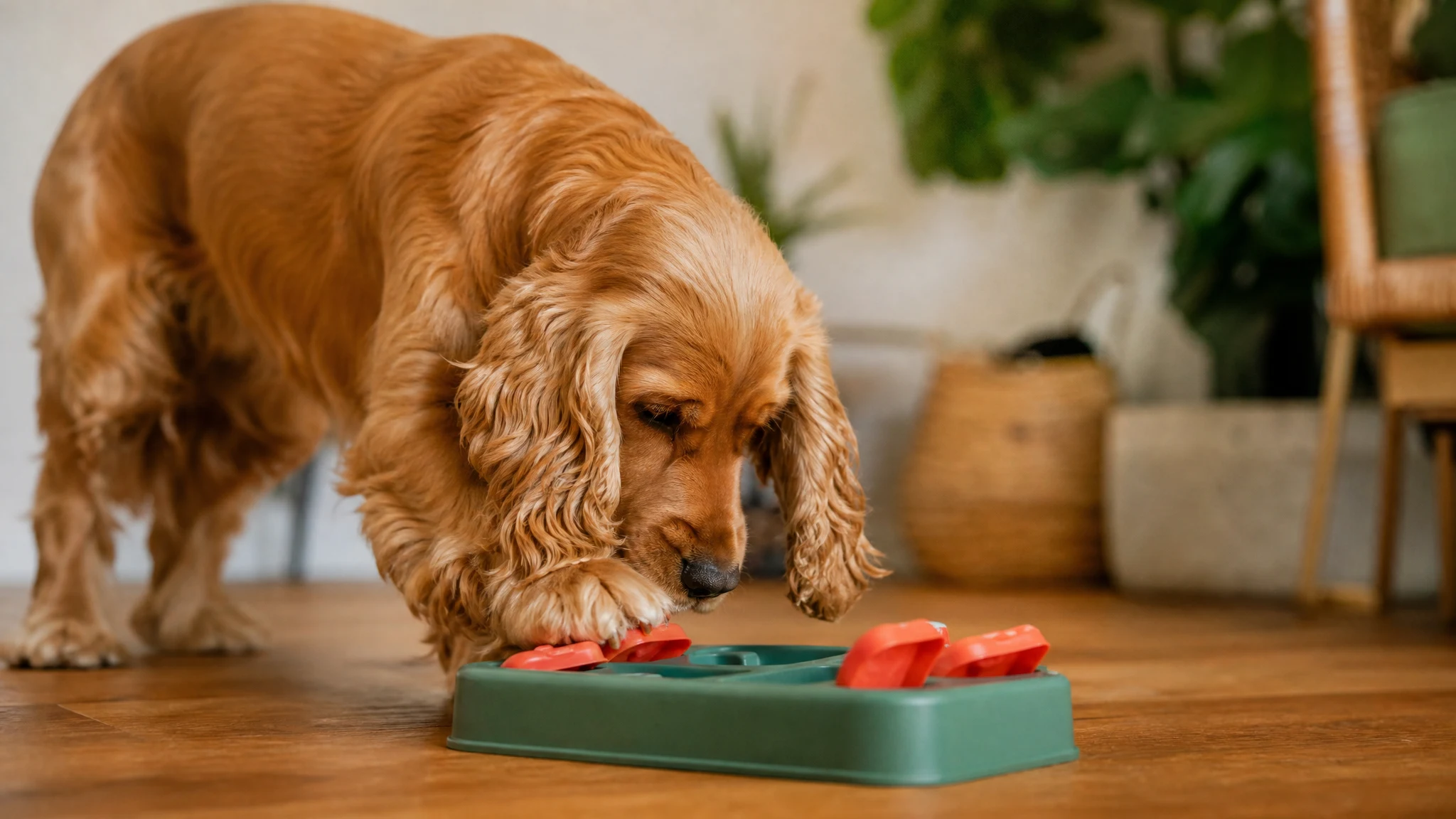
A bowl empties in 30 seconds. A puzzle feeder can take several minutes and gives the brain a workout. Use part of your dog's regular meal so that you do not add extra calories.
- Snuffle mat: sprinkle kibble into the folds and let your dog sniff it out.
- Muffin tin game: put treats in some cups, cover each cup with a tennis ball and let your dog lift them out.
- Scatter feed: toss kibble across the lawn so your dog hunts for it.
Start with easy versions so your dog feels successful. Make it harder only when they are confident.
Step 6: Play training games based on the original job
This is where English Cocker Spaniel mental stimulation really pays off. Because the breed was developed to find, flush and retrieve, games that copy those steps feel natural.
Find it (the "find" part). Show your dog a treat, then let them watch you hide it under a towel or behind a chair. Say "find it" and let them search. Next, hide treats where your dog cannot see you do it. Increase the distance slowly.
Box search. Place several open boxes on the floor, with a treat in only one. Let your dog sniff each box until they find the right one. Praise calmly when they do.
Hide and seek (the "flush" part). Ask your dog to wait, hide somewhere easy in the house, then call them. Reward them with a party when they find you. This also builds recall.
Fetch and carry (the "retrieve" part). Teach your dog to pick up a toy, bring it to you and give it up for a treat. Trade one toy for another instead of pulling it away. A soft mouth and a happy return are the goal.
Short trick sessions. Orvis suggests keeping sessions short and varied. Try three to five minutes of one skill, then switch to something different. A few quick rounds are better than one long, repetitive one.
If you want to build a wider foundation, our complete guide to English Cocker Spaniel training covers the basics step by step.
Step 7: Finish with a calm-down
After exercise, give your dog a quiet routine. Offer water, a gentle brush and a chew or a settle mat. Reward calm behavior. This teaches your dog that activity ends and relaxing is part of the day.
Step 8: Review and adjust weekly
Once a week, look at how your dog is doing. Are they settled in the evening? Are they destroying things less? Is the weight steady? If something is off, change one thing at a time, such as adding a puzzle meal or a second sniff walk. If you are worried about weight, stiffness or behavior changes, talk to your veterinarian.
Sample Day for a Healthy Adult
- Morning: a brisk walk with some off-leash or long-line time, then a puzzle breakfast.
- Midday: a short training game, such as find it or box search.
- Afternoon or evening: a relaxed sniff walk, plus fetch and carry.
- Night: a chew or settle mat while the household winds down.
This is an example, not a prescription. Adjust it to your dog's age, health, weather and your own schedule.
Tips for Success
- Keep treats small. Count training treats as part of the daily food so your dog stays at a healthy weight.
- Quit while your dog is still keen. End each game on a success.
- Rotate the games. Variety keeps a smart dog interested.
- Use a long line until recall is solid. A spaniel with a nose full of scent may not hear you.
- Exercise with your dog. The breed likes company, and shared time builds your bond.
- Stay positive. If your dog gets stuck, make the task easier and try again.
Common Mistakes to Avoid
- Only adding more running. A tired body does not always mean a satisfied mind. A dog who gets fitter may simply need more, so add brain work.
- Overdoing it with a puppy. Growing joints need care. Ask your veterinarian before starting long runs, jumping or repeated fetch.
- Leaving the dog in the yard. As noted above, the breed prefers company and is not suited to being left alone in a backyard.
- Rushing sniff walks. Letting your dog sniff is the point. Pulling them along takes away the mental benefit.
- Making games too hard too fast. Frustration can lead to giving up or to barking.
- Using harsh methods. Shock, prong or choke collars and dominance techniques are not recommended and go against AVSAB guidance. Reward what you like instead.
- Ignoring pain signs. If your dog limps, slows down suddenly or seems sore, stop and call your veterinarian.
What Results Can You Expect?
With a steady routine, many owners find their dog is calmer at home, more focused on training and less likely to pick up bad habits out of boredom. A mix of exercise and mental work may also help your dog sleep more soundly. Results depend on the individual dog, its age, its health and how consistent you are, so they are not guaranteed.
Give any new routine a few weeks before judging it. If you see no change, or if your dog seems unwell, speak with your veterinarian. Your dog may also enjoy organized activities. Westminster lists the show ring, obedience, agility, tracking and hunting for the breed, and the parent club lists Performance events and Junior Showmanship. Check with the English Cocker Spaniel Club of America for details on events and clubs.
Final Thoughts
English Cocker Spaniel exercise is about more than miles. Give your dog plenty of daily activity, a good sniff and a job to do with their brain, and you will likely have a happier companion. Start gently, match the plan to your dog's life stage and let your veterinarian guide you on anything health-related.